From a Simple Question: The Story of How ChurchCRM Started
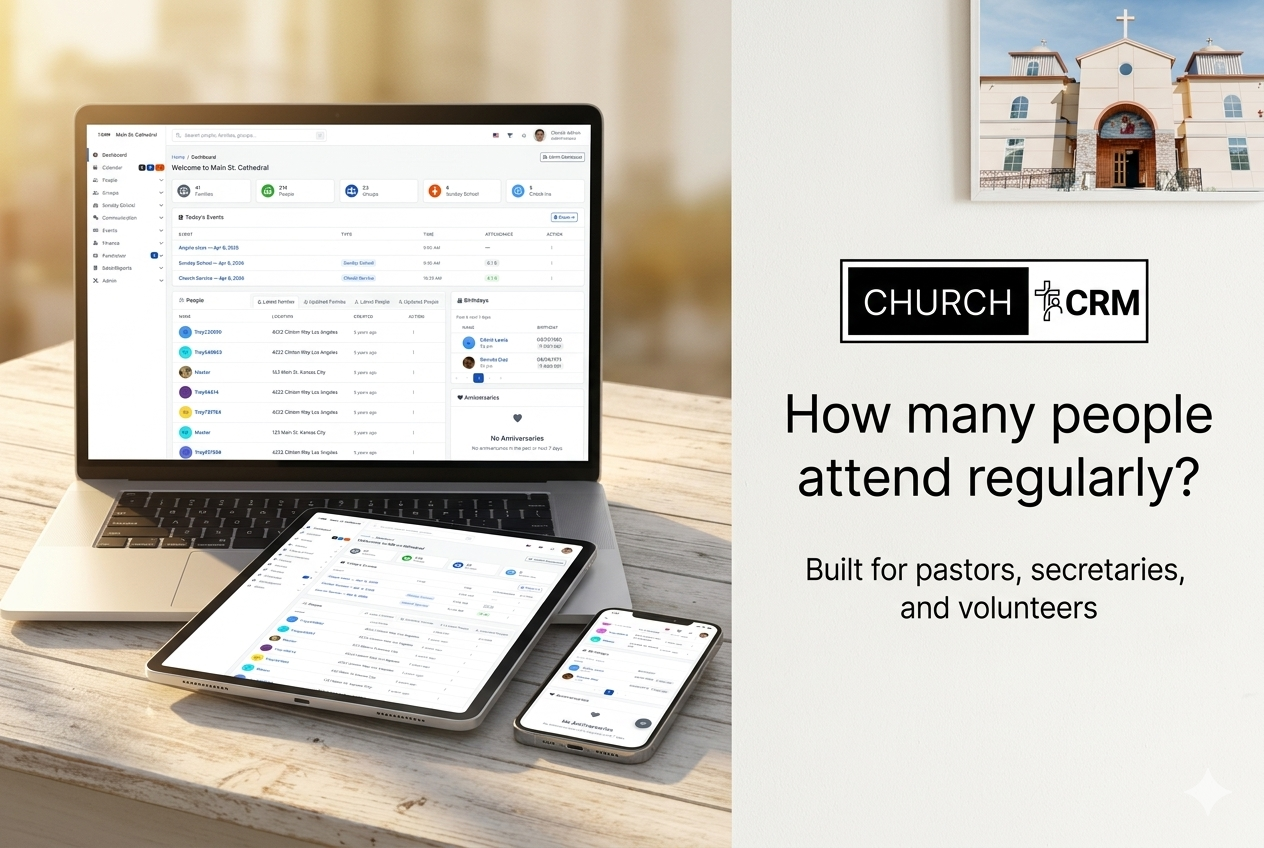
It started with a question.
We were sitting in a St. George’s volunteer meeting — the kind of meeting where everyone means well and the agenda is handwritten on a yellow legal pad — when someone asked what seemed like the most basic question imaginable.
“How many people do we actually have in our congregation?”
Silence.
Not because we didn’t care. We cared enormously. But because between the paper sign-in sheets, the three different spreadsheets, the email list that nobody could remember the password to, and the handwritten directory that was last updated never, nobody could give a confident answer.
That moment bothered me more than it should have.
Looking for a Solution
I went looking for church management software. There was plenty of it. The problem was the price — $50 a month here, $14 to $199 a month there, and usually a per-member fee that punished a congregation for growing. For a church running on offerings and volunteer hours, paying a software company hundreds of dollars a year just to know who attended last Sunday felt wrong.
There had to be another way.
There was. It was called ChurchInfo — an older, open-source church administration project that had been quietly doing real work for real congregations. It wasn’t pretty. It wasn’t modern. But it was free, it was self-hosted, and it belonged to no vendor.
I started to modify it to match our church’s needs.
Building It in the Open
What happened next was not a startup. There was no pitch deck, no MVP launch, no growth hacking. There was just a conviction — software should serve the mission, not the other way around — and a community of developers, pastors, and church administrators who felt the same way.
We rewrote the codebase. We modernized the interface. We added features that small and medium congregations actually needed: member profiles that anyone could maintain, giving and pledge tracking, Sunday School roster management, an event system, a self-service portal so members could update their own information.
Most importantly, we kept it free. Completely, unconditionally free. Because a congregation in Lagos or Bogotá or rural Saskatchewan deserves the same tools as a megachurch with a software budget.
What It Became
I won’t pretend I knew it would grow like this.
Today ChurchCRM is used by thousands of congregations across six continents. It runs in 49 languages, with translations maintained by community volunteers who give their time because they believe their congregation deserves software in their mother tongue. There have been 100+ releases. More bug fixes, feature requests, and support conversations than I can count.
None of it is managed by a company. There is no board, no investors, no monetization strategy. There is a community of people who use the software, improve it, and help others use it — because that is what open-source communities do when they are working on something that matters.
Why It Still Matters
Paid church management software has gotten better. The market has options now that didn’t exist when we started. But the economics haven’t changed. A church of 80 people paying $50 a month is spending $600 a year on software. That is a mission trip that doesn’t happen. That is a food pantry that runs a little shorter. That is a choice no congregation should have to make.
ChurchCRM will always be free. It will always be self-hosted — your data on your server, belonging to you and no one else. And it will always be open-source, because an auditable codebase is a trustworthy one, and trust matters when you are handling a congregation’s giving records and pastoral notes.
If you are reading this because you are looking for church management software, try the demo. No signup required. See if it does what you need.
If you are reading this because you are a developer who cares about faith-based open source, the code is on GitHub. Pull requests welcome.
And if you are reading this because someone in your volunteer meeting just asked a question nobody could answer — welcome. That is exactly how this started.
George Dawoud is the founder of ChurchCRM. You can follow the project on GitHub and connect on Discord.