Six New Locales in ChurchCRM 7.x — Now Speaking Malayalam, Filipino, and Four Flavors of Spanish
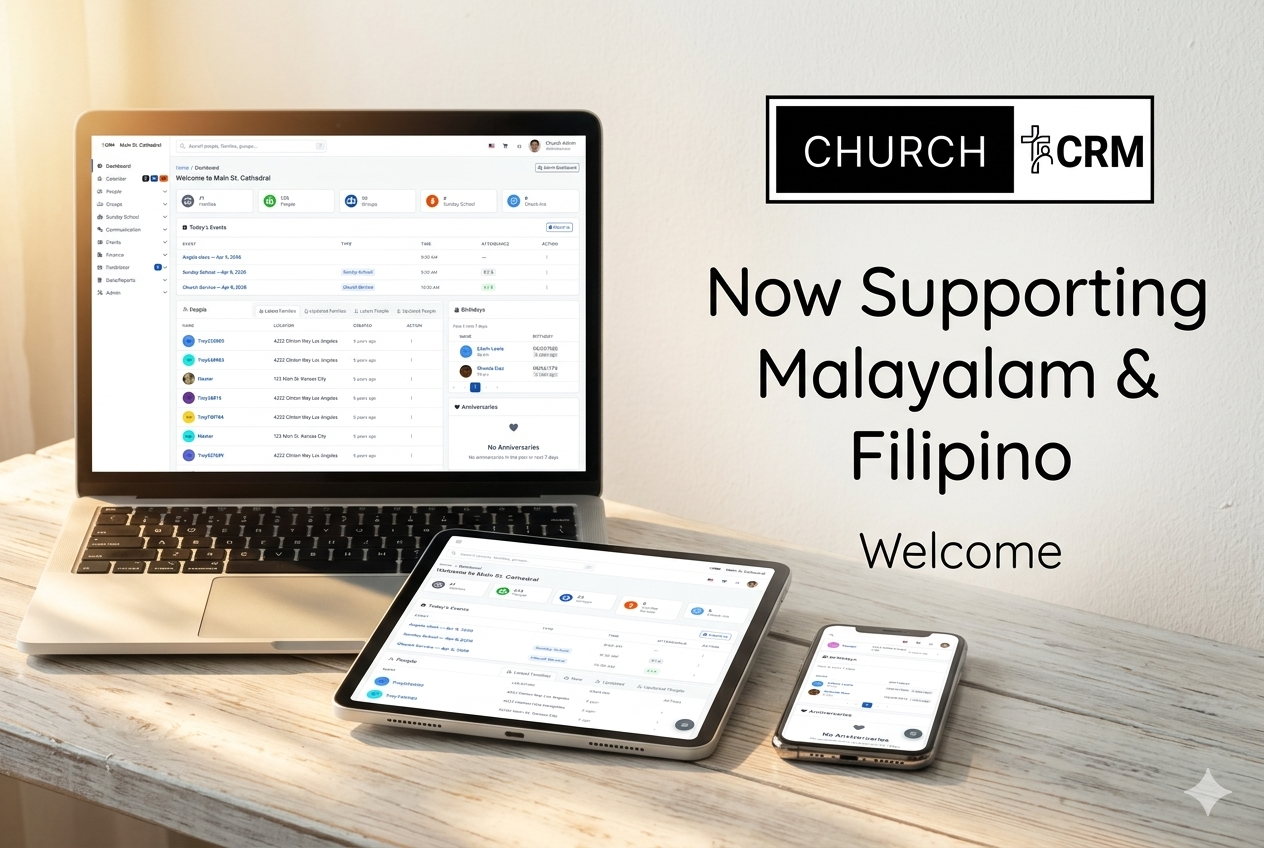
One of the quietest — and most important — things that happens in every ChurchCRM release is that the software learns to speak a few more languages. Not because we paid a translation firm. Because somebody on the other side of the world, who is part of a church, sat down and translated it themselves.
Since 7.1.0 shipped, two new locales have joined the family:
| Locale | Language | Where | Version |
|---|---|---|---|
🇮🇳 ml_IN | Malayalam | Kerala, India | 7.1.0 |
🇵🇭 tl_PH | Filipino (Tagalog) | Philippines | 7.1.0 |
That brings ChurchCRM to 47 locales — more than any paid church management platform we know of, by a very wide margin.
Malayalam: A First for ChurchCRM in Kerala
Malayalam (മലയാളം) is the official language of the Indian state of Kerala and is spoken by roughly 38 million people. It has one of the oldest Christian communities in the world — tradition holds that the Apostle Thomas brought the faith to the Malabar Coast in AD 52.
Until 7.1.0, there was no free, self-hosted church management software in Malayalam. There is now.
This work was contributed as a volunteer effort by a member of the ChurchCRM community, and it is — to our knowledge — the first complete church management platform in the language. The translation covers over 3,400 strings across the entire application.
To every Malayalam-speaking church using ChurchCRM for the first time this Easter season: welcome home.
സ്വാഗതം. (Svāgatam — “Welcome.”)
Filipino (Tagalog): For the Churches of the Philippines
The Philippines has one of the largest Christian populations in Asia — roughly 90 million people identify as Christian, across Catholic, Evangelical, and Independent traditions. English is widely used in Philippine churches, but Filipino (the standardized form of Tagalog) is the language people pray in, sing in, and welcome each other in.
ChurchCRM 7.1.0 shipped with a full Filipino translation — 3,438 strings — contributed by a volunteer translator and delivered in 23 review batches over several weeks. It is a remarkable piece of work.
Maligayang pagdating. (“Welcome.”)
Why Localization Is a Theology Question
It would be easier to ship ChurchCRM in English only. English is the language of most open-source software. Most of our developers work in it. Most of our documentation is written in it. Going multilingual is hard — it affects every screen, every report, every error message, every date format.
We do it anyway, because we believe three things:
Every church deserves the same tools. Not “the same tools in English.” The same tools, full stop. A rural parish in Kerala should have access to the same administrative software as a megachurch in Texas, and both should have it in the language they actually speak at home.
Language is not a luxury. When a volunteer treasurer has to use software in a second language, they make more mistakes, they work more slowly, and they burn out faster. Localization isn’t a nice-to-have — it’s stewardship of your volunteers’ time.
Software in your language tells you that you belong. When a piece of software greets you in the language your grandmother prayed in, it tells you that the people who built it thought about you. That matters, especially for communities that are used to being an afterthought.
Thank You
To every translator who has ever touched ChurchCRM — whether you added one string or thirty-four hundred — we are grateful. You are the reason a church admin in San Salvador or Kochi can open this software this morning and understand what it’s telling them. That is ministry.
We have a lot more languages to reach. If you’d like to help, the community translation project lives on POEditor and the contributing guide explains how to join. No coding required. No obligation. Just your language and your time.
From the whole ChurchCRM volunteer team:
🇮🇳 നന്ദി (Nandi) 🇵🇭 Salamat po
Thank you.
Want to try ChurchCRM in your language? Try the live demo — 47 locales, free forever, self-hosted. Or read the installation guide to set it up on your own server.
Editor’s note: Localized phrases above were drafted by the ChurchCRM team for tone, not final accuracy. Native speakers from each community should review before publication.